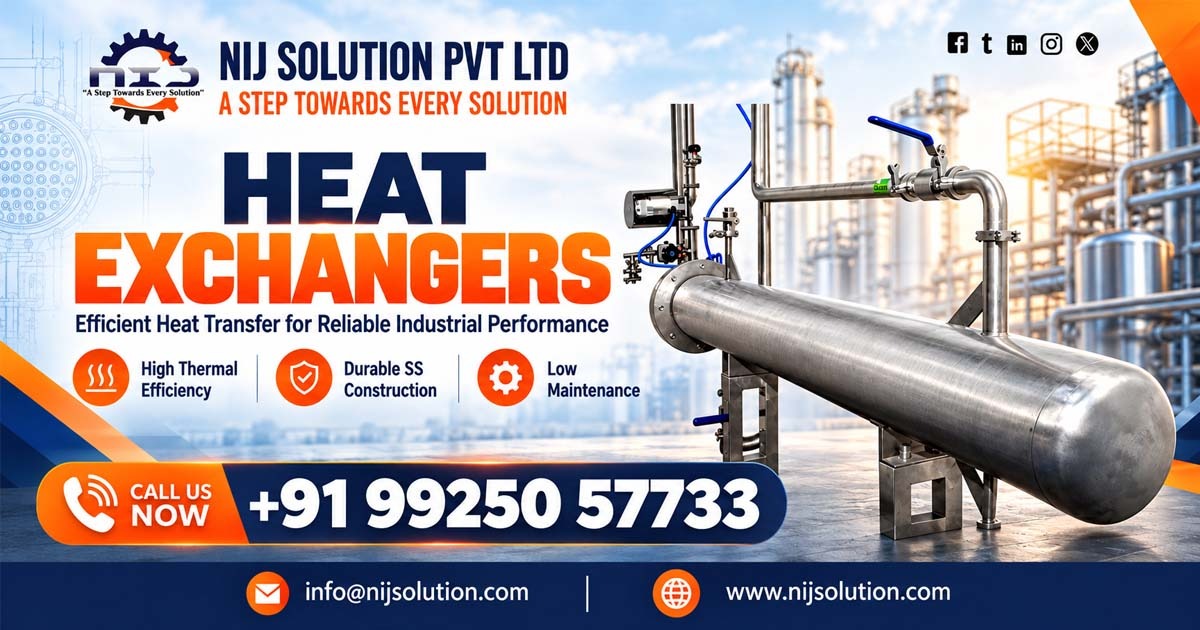
Industrial heat transfer depends on selecting equipment that matches the process, operating temperature, fluid properties, and available space. For buyers seeking a Heat Exchangers Supplier In Uttar Pradesh, Nij Solution Pvt. Ltd. can be a point of contact for discussing equipment requirements and project needs.
What Should Buyers Define Before Selecting a Heat Exchanger?
A heat exchanger transfers heat between two fluids, usually without allowing them to mix. It may be used to heat a process liquid, cool circulating water, or maintain a required temperature during production.
Before approaching a supplier, prepare the following process details:
- Thermal duty: The amount of heat that needs to be transferred.
- Inlet and outlet temperatures: The required temperature change for both fluids.
- Flow rate: The volume or mass of each fluid moving through the equipment.
- Operating pressure: The pressure conditions on both sides of the exchanger.
- Fluid properties: Chemical composition, viscosity, suspended solids, and corrosion potential.
These details help engineers assess the appropriate exchanger design and reduce the risk of selecting equipment that cannot meet the actual process requirement.
Matching the Exchanger Design to the Industrial Process
The equipment configuration should suit the application rather than being selected only by size or purchase price.
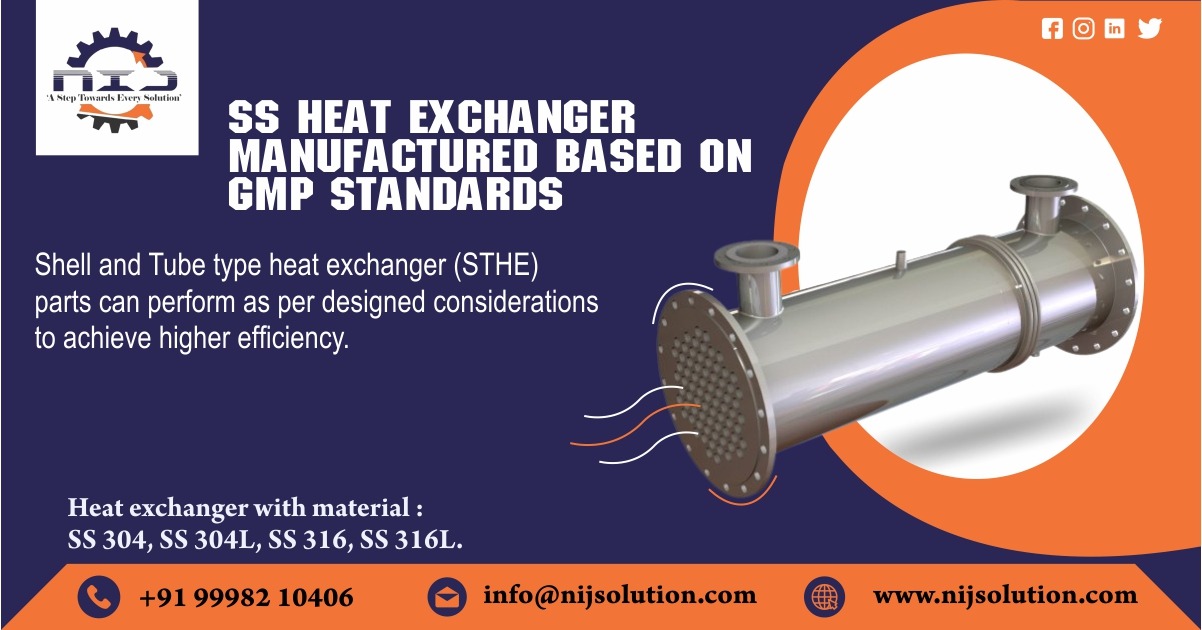
A shell-and-tube heat exchanger uses tubes enclosed within a shell, allowing one fluid to flow through the tubes and another through the surrounding space. It can be considered for a range of industrial heating and cooling duties.
A plate heat exchanger uses closely arranged plates to transfer heat between fluid streams. Its suitability depends on pressure, temperature, fluid cleanliness, gasket compatibility, and cleaning requirements.
When evaluating a Heat Exchangers Supplier In Uttar Pradesh, buyers should explain whether the equipment will handle clean water, process liquids, hot utility streams, or fluids that may cause scaling or deposits. The supplier can then assess which configuration is appropriate for the intended service.
Material Selection Can Affect Operating Reliability
The material in contact with the process fluid must be compatible with the fluid’s chemical properties and operating conditions. Stainless steel may be suitable for many industrial duties, but the correct grade depends on factors such as chloride content, temperature, cleaning chemicals, and corrosion risk.
Buyers should confirm:
- The material proposed for tubes, plates, shell, and other wetted components.
- Gasket or sealing material compatibility, where applicable.
- Maximum design temperature and pressure.
- The expected presence of scale, deposits, or suspended particles.
- The cleaning method planned for routine maintenance.
For example, a process involving frequent chemical cleaning may require a different material assessment from a system handling relatively clean water. Material selection should therefore be based on the complete operating environment, not just the fluid name.
Installation Planning: Check the Space and Connections
Even a correctly selected heat exchanger can create operational difficulties if the installation layout is not planned properly.
Before ordering, measure the available installation area and check the location of inlet and outlet pipelines, valves, pumps, supporting structures, and nearby equipment. Allow enough access for inspection, cleaning, and component removal.
The project team should also confirm:
- Foundation or mounting requirements, where applicable.
- Pipeline routing and connection sizes.
- Electrical and utility needs for associated equipment.
- Safe access for operation and servicing.
- Commissioning checks and integration with existing process controls.
For plants in Uttar Pradesh, sharing the site layout and piping information during the quotation stage can help identify installation constraints before equipment reaches the facility.
Preventing Fouling and Unplanned Maintenance
Heat transfer surfaces can accumulate scale, dirt, biological deposits, or process residues. This fouling can reduce heat transfer and restrict fluid flow, making inspection and cleaning important parts of equipment planning.
A practical maintenance plan should include:
- Monitoring changes in outlet temperature, flow, and pressure drop.
- Inspecting for visible leakage, corrosion, or unusual operating conditions.
- Cleaning heat transfer surfaces using a method compatible with the equipment materials.
- Checking seals, gaskets, connections, and accessible components.
- Keeping relevant maintenance records and identifying spare parts before they are urgently needed.
If heating or cooling performance declines, investigate changes in fluid flow, deposits, operating conditions, and utility supply before assuming that the exchanger itself needs replacement. Isolate the equipment and follow approved site procedures before inspection or servicing.
Supplier Evaluation and Pre-Purchase Checks
A quotation should be evaluated against the process requirement, not just the equipment price. When comparing a Heat Exchangers Supplier In Uttar Pradesh, request clear technical information that allows your engineering and procurement teams to assess whether the offered unit suits the project.
Use this checklist before approving an order:
- Confirm the required heat duty, flow rates, temperatures, and design pressure.
- Review the proposed exchanger type and construction materials.
- Verify dimensions, nozzle positions, connection details, and available installation space.
- Ask what inspection and pressure or leak testing will be performed, as applicable.
- Confirm the scope of supply, drawings, operating documents, and maintenance instructions.
- Discuss cleaning access, spare parts, installation assistance, and technical support.
- Record any customization requirements and confirm them in the final quotation.
Avoid selecting solely on the lowest initial price. A unit that is difficult to clean, unsuitable for the process fluid, or awkward to install may create additional costs during operation.
Services
Nij Solution Pvt. Ltd. provides industrial equipment and engineering-related services. Depending on the project scope, relevant support areas for heat exchanger requirements may include:
- Heat exchanger requirement assessment and equipment selection.
- Process piping and connection planning for equipment integration.
- Custom fabrication coordination based on approved project requirements.
- Installation planning and technical assistance for industrial systems.
Confirm the exact scope, deliverables, and service availability with the company before placing an order.
Location
Industrial buyers across Uttar Pradesh can assess heat exchanger requirements according to their plant processes, utility systems, and installation conditions. Relevant industrial and commercial locations include Noida, Greater Noida, Ghaziabad, Meerut, Modinagar, Hapur, Bulandshahr, Lucknow, Kanpur, Unnao, Agra, Mathura, Aligarh, Bareilly, Moradabad, Rampur, Shahjahanpur, Prayagraj, Varanasi, Gorakhpur, Ayodhya, Jhansi, and Firozabad.
Discussing Your Heat Exchanger Requirement With Nij Solution Pvt. Ltd.
Nij Solution Pvt. Ltd. lists heat exchangers among its industrial products and provides related industrial water-system and process engineering services.
Buyers seeking a Heat Exchangers Supplier In Uttar Pradesh can share their process requirements, fluid details, operating temperatures, pressure conditions, and installation constraints for an initial discussion. Manufacturing support is based in Ahmedabad, Gujarat, India.
Visit Nij Solution Pvt. Ltd. to explore its industrial product range and submit an enquiry. The company can discuss the requirement and clarify the applicable equipment and service scope before a purchase decision.
Frequently Asked Questions
Q1. What information is needed to obtain a heat exchanger quotation?
A: Share the required heat duty, inlet and outlet temperatures, flow rates, operating pressure, fluid composition, and installation details. Existing equipment drawings can also help clarify the requirement.
Q2. How can buyers decide between a shell-and-tube and a plate heat exchanger?
A: Compare the process fluids, pressure and temperature conditions, fouling tendency, available space, and cleaning method. The final selection should be based on the specific duty and engineering assessment.
Q3. What should be checked when replacing an existing heat exchanger?
A: Check the existing unit’s performance, connection positions, dimensions, pressure drop, material condition, and operating history. Confirm that the replacement meets the current process duty and fits the installation layout.
Q4. Can a heat exchanger be integrated into an existing industrial system?
A: Yes, integration may be possible after checking the available space, piping arrangement, flow requirements, utility connections, and process controls. Site conditions and equipment compatibility should be confirmed before installation.
Conclusion
Successful heat exchanger procurement starts with a clear understanding of process conditions, material compatibility, cleaning needs, and installation constraints. Industrial buyers in Uttar Pradesh should evaluate both technical suitability and long-term maintenance requirements. Nij Solution Pvt. Ltd., with manufacturing support from Ahmedabad, Gujarat, India, can be contacted to discuss project requirements.
Planning a new installation or replacement? Contact Nij Solution Pvt. Ltd. to discuss your heat transfer requirements and equipment selection.
Call Us:
+91 99250 57733
+91 99982 10406
+91 76985 37842
079-29611075
Email: info@nijsolution.com