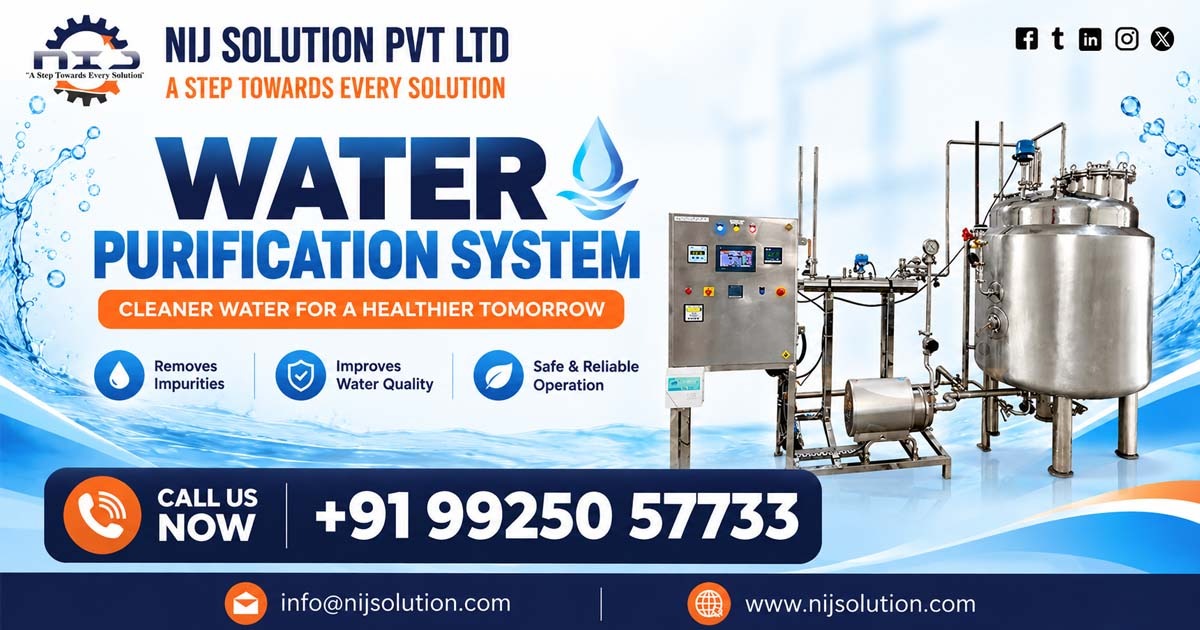
Industrial water quality can affect production, equipment condition, cleaning processes, and final product quality. Businesses in Bihar should identify their raw water characteristics and actual process needs before selecting an industrial water purification system.
How Water Quality Problems Can Affect Industrial Operations
Water that appears clear may still contain dissolved salts, hardness, suspended particles, or other impurities. The type and concentration of these substances determine whether the water is suitable for a particular industrial process.
For example, a manufacturing unit may need water for equipment washing, boiler feed preparation, product processing, or general utilities. Each application can require a different level of treatment.
An Industrial Water Purification System in Bihar for Clean Water should therefore be selected according to the source of water, daily demand, and required output quality rather than price alone.
Identify the Water Problem Before Selecting Equipment
The first step is to understand what needs to be removed from the incoming water. Groundwater, municipal supplies, and surface water can have different characteristics, so a standard treatment arrangement may not suit every site.
A raw water analysis can help identify important parameters such as:
- Turbidity and suspended solids: These can affect clarity and may require suitable filtration.
- Hardness: Calcium and magnesium can contribute to scaling in pipes, heat exchangers, and other equipment.
- Dissolved salts: High concentrations may require a suitable desalination process, depending on the intended use.
- Iron and other specific contaminants: Treatment depends on their concentration and chemical form.
- Microbiological contamination: Where relevant, an appropriate disinfection stage may be required.
The objective is to identify the actual treatment requirement before deciding which equipment to install.
Match the Treatment Process to the Intended Use
Industrial water purification is not a single process. Different treatment stages address different water quality problems, and a complete system may combine several technologies.
| Treatment method | Typical purpose |
| Media filtration | Reducing suspended particles and turbidity |
| Activated carbon filtration | Reducing certain organic compounds, odour, or chlorine where appropriate |
| Water softening | Reducing hardness that contributes to scaling |
| Reverse osmosis (RO) | Reducing many dissolved salts and other constituents, depending on feed water and membrane performance |
| UV or other disinfection | Controlling microorganisms when suitable for the application |
These methods are not interchangeable. For example, a softener is not a substitute for an RO system when dissolved salt reduction is required. Similarly, filtration alone does not guarantee microbiologically safe water.
The treatment sequence should be determined through water analysis, required output quality, and the operating conditions of the plant.
Calculate the Water Demand Across the Plant
An industrial purification system must supply enough treated water for normal operations without creating unnecessary treatment or storage costs.
Before requesting a quotation, estimate:
- Daily consumption: Total water needed during a normal production day.
- Peak demand: The highest short-term requirement during production, cleaning, or simultaneous equipment use.
- Required treated-water output: The usable water volume needed after accounting for treatment losses and reject streams, where applicable.
- Storage requirements: Whether treated water needs to be stored between production cycles or supplied continuously.
RO systems, for example, do not convert all incoming water into treated water. Recovery depends on feed-water quality, system design, and operating conditions. Capacity calculations should account for this difference.
Plan the System Around Existing Plant Infrastructure
Installing water treatment equipment involves more than choosing filtration units. The system must fit the site’s available space and connect correctly with the existing water supply and distribution network.
Industrial buyers should check the following before finalizing the equipment:
- Available floor space and access for replacing filters or servicing components.
- Raw water supply pressure, flow rate, and storage arrangements.
- Electrical supply and any required control-panel connections.
- Drainage arrangements for backwash water, cleaning waste, or RO reject water.
- Compatibility with existing tanks, pumps, pipelines, and downstream equipment.
For pharmaceutical, food, beverage, and dairy operations, buyers may also need to evaluate hygienic design, water quality monitoring, and applicable process requirements. These details should be agreed upon during technical discussions rather than left until installation.
Avoid These Common Procurement Mistakes
A low initial quotation does not necessarily represent the lowest overall operating cost. Differences in treatment stages, consumables, water recovery, maintenance requirements, and instrumentation can make two quotations difficult to compare.
Reduce purchasing uncertainty by checking these points:
- Buying without a water test: Request a raw water analysis before finalizing the treatment design.
- Choosing capacity only by daily consumption: Confirm peak demand and required operating hours.
- Ignoring operating costs: Evaluate filter replacement, chemicals, electricity, membranes, and wastewater handling where applicable.
- Accepting unclear specifications: Ask for the proposed process sequence, design assumptions, output-water parameters, and scope of supply in writing.
- Overlooking maintenance access: Confirm that routine inspections and replacement of consumables can be carried out safely.
A clear technical specification helps procurement teams compare suppliers on equivalent requirements instead of comparing prices for potentially different systems.
Industrial Water Purification Requirements Across Bihar
Bihar-based businesses may have different water treatment needs depending on their industry, water source, production schedule, and intended use. A food-processing facility may prioritize process-water quality, while a utility system may focus on hardness control or dissolved-solids reduction.
When planning a project, businesses should consider the local site’s water availability, space constraints, electrical infrastructure, drainage, and access for equipment maintenance. The supplier should assess these conditions before recommending a configuration.
Relevant cities and business locations for industrial water treatment planning include Patna, Gaya, Muzaffarpur, Bhagalpur, Darbhanga, Purnia, Bihar Sharif, Begusarai, Katihar, Munger, Chhapra, Ara, Buxar, Samastipur, Hajipur, Siwan, Motihari, Bettiah, Kishanganj, Jamalpur, Sasaram, Dehri, Sitamarhi, Madhubani, and Jehanabad.
These locations are potential areas for industrial requirements, not a confirmation of service coverage at every location.
Four Service and Support Considerations
For an industrial water purification project, buyers can discuss the following areas with the supplier and confirm which services are included in the quotation.
- Requirement assessment: Share the raw water source, water analysis, intended application, and expected demand to establish the treatment requirements.
- Technical configuration: Review the proposed treatment stages, output-water targets, capacity, and utility requirements before approving the design.
- Manufacturing and project coordination: Confirm the equipment supply scope, documentation, delivery schedule, and responsibilities for connecting the system to the plant.
- Maintenance planning: Discuss routine servicing, consumables, spare parts, and the availability and terms of any after-sales support.
The exact scope and availability of each service should be confirmed directly with the supplier.
Nij Solution Pvt. Ltd. for Industrial Water Treatment Requirements
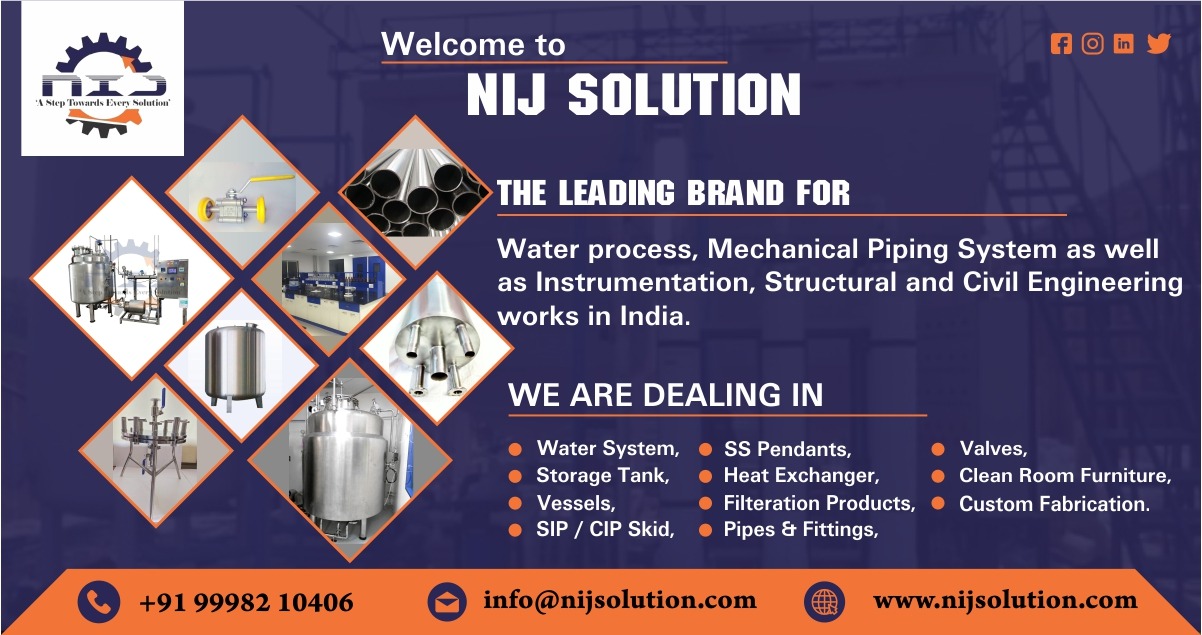
Nij Solution Pvt. Ltd. provides industrial water management systems and works with water treatment plants, associated spares, process piping, and engineering services. Its website also describes water system design and manufacturing, as well as annual maintenance and operation and maintenance contracts.
The company’s manufacturing support is based in Ahmedabad, Gujarat, India. Businesses in Bihar evaluating an industrial water purification system can share their water quality report, intended application, capacity requirement, and site details to begin a technical discussion.
Visit the official website: https://nijsolution.com/
For a more meaningful evaluation, ask for a proposed treatment sequence and written specifications based on your plant’s actual requirements. Do not finalize the equipment until the output-water criteria, supply scope, and installation responsibilities are clear.
Frequently Asked Questions
1. How do I select an industrial water purification system in Bihar?
Start with a raw water analysis and identify the required treated-water quality. Then compare treatment methods, capacity, operating costs, site conditions, and maintenance requirements.
2. Is an RO system necessary for every industrial application?
No. RO is useful when reducing dissolved salts is required, but some applications may need filtration, softening, or other treatment processes instead. The choice depends on the water analysis and intended use.
3. Which factors affect the cost of an industrial water purification system?
Cost depends on water quality, treatment capacity, selected technologies, automation, materials, storage, installation scope, and operating requirements. A reliable quotation should specify what is included and any additional costs.
4. Can Nij Solution Pvt. Ltd. support a water treatment project in Bihar?
Nij Solution Pvt. Ltd. provides industrial water treatment-related products and services, with manufacturing support in Ahmedabad, Gujarat, India. Contact the company directly to confirm project suitability, delivery arrangements, and the availability of required support in Bihar.
Conclusion
Selecting an industrial water purification system requires more than estimating daily water consumption. Buyers should understand the incoming water quality, define the required output, and evaluate treatment methods, operating costs, and site requirements. A clear technical scope helps businesses make informed procurement decisions and plan for long-term operation.
Planning a water treatment project in Bihar? Contact Nij Solution Pvt. Ltd. through nijsolution.com to discuss your water analysis, capacity requirements, and suitable treatment options.
Call Us:
+91 99250 57733
+91 99982 10406
+91 76985 37842
079-29611075
Email: info@nijsolution.com