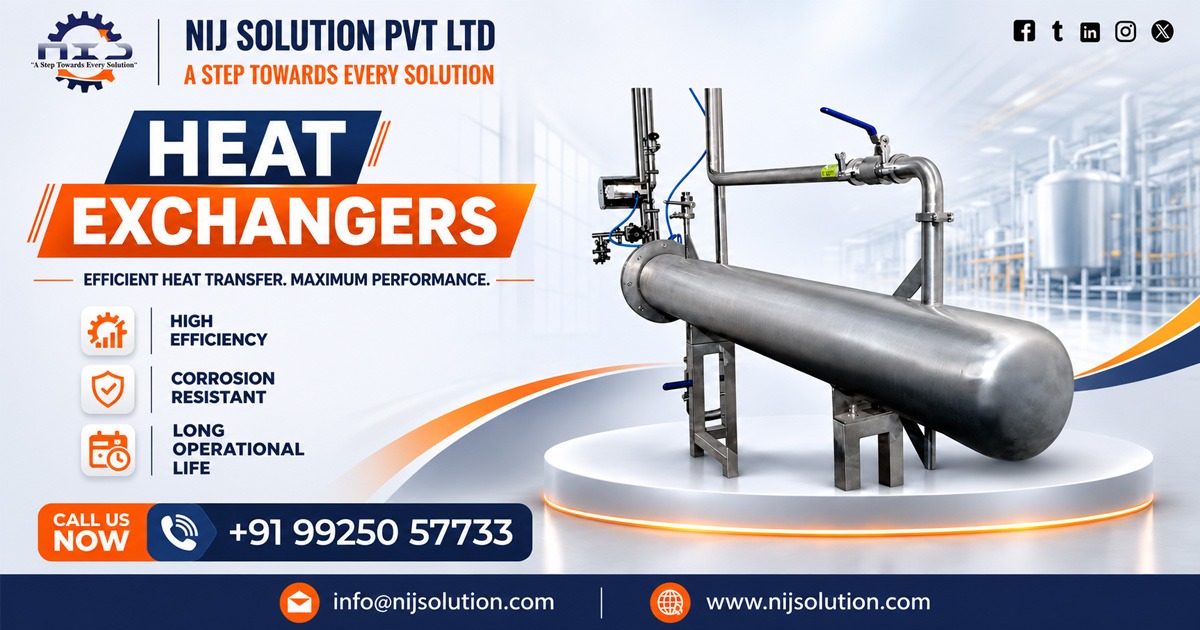
Industrial heat exchangers play an important role in controlling process temperatures, recovering heat, and supporting stable production in manufacturing facilities. Businesses in Nagaland evaluating Industrial Heat Exchangers for Process Applications In Nagaland should consider fluid properties, operating temperatures, pressure conditions, and equipment compatibility before selecting a suitable system.
Understanding Heat Transfer in Industrial Processes
A heat exchanger transfers thermal energy from one fluid to another without requiring the fluids to mix directly. It helps industrial operators heat, cool, or maintain process fluids at required temperatures during production.
Depending on the application, heat exchangers may be used for:
- Heating process water or liquid materials.
- Cooling fluids before the next production stage.
- Transferring heat between utility and process streams.
- Supporting temperature control in manufacturing vessels.
- Recovering usable heat from hot process fluids.
In industries where temperature consistency affects product quality, a properly selected exchanger helps maintain process conditions and supports smoother operations.
How Shell-and-Tube Heat Exchangers Manage Thermal Exchange
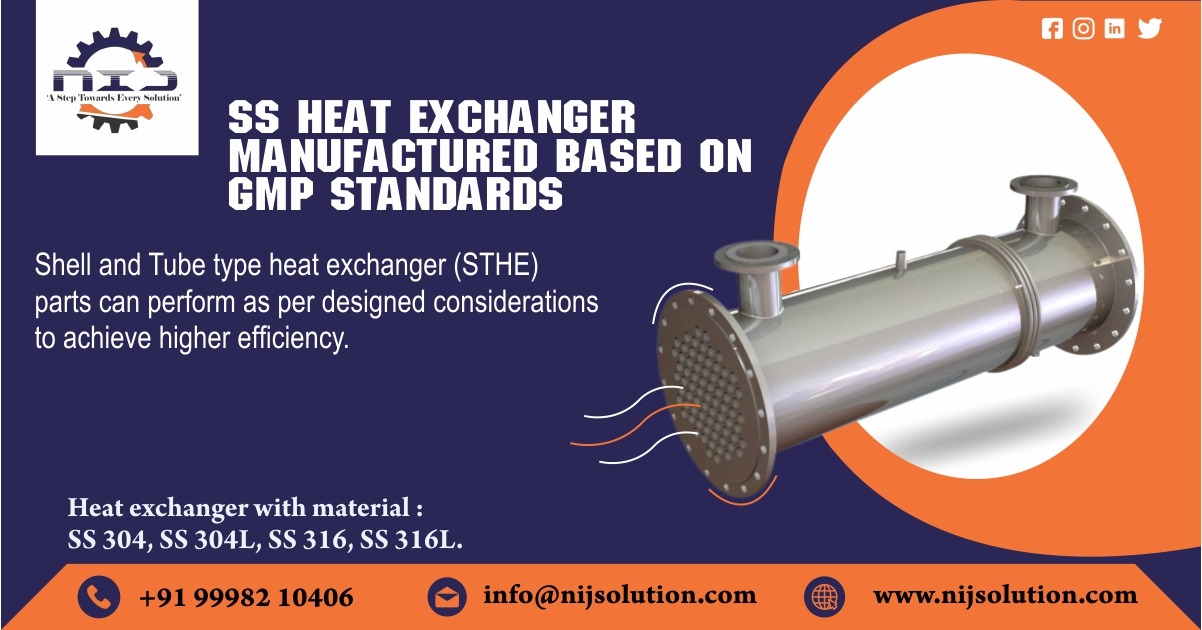
A shell-and-tube heat exchanger uses a collection of tubes enclosed within a larger shell. One fluid passes through the tubes, while another flows around the tubes inside the shell. Heat moves through the tube walls from the hotter fluid to the cooler fluid.
The main design elements include:
- Tube bundle: Provides the heat-transfer surface between the two fluids.
- Shell: Contains the external fluid and guides its flow around the tubes.
- Baffles: Direct fluid movement across the tube bundle and can help improve heat-transfer contact while supporting the tubes.
- Inlet and outlet connections: Allow the two fluid circuits to enter and leave the equipment.
- Flow arrangement: Parallel flow, counterflow, crossflow, or multiple-pass configurations influence thermal performance.
Shell-and-tube exchangers are relevant to industrial heating and cooling applications where the process, fluid characteristics, and equipment layout determine the required design. Nij Solution’s published product information identifies shell-and-tube heat exchangers among its offerings.
Where Heat Exchangers Fit into Industrial Operations
Heat transfer requirements can vary considerably between industries. A system used for heating process water may have different requirements from one handling a chemical solution or cooling a production stream.
Common application areas include:
- Pharmaceutical manufacturing: Heating and cooling process liquids, water systems, and production-related equipment.
- Food and beverage processing: Temperature management for process fluids and supporting production operations.
- Dairy processing: Thermal control for liquids used during processing and utility operations.
- Chemical manufacturing: Heating or cooling fluids according to process requirements.
- Petrochemical operations: Managing heat in selected process and utility streams.
For industrial buyers exploring Industrial Heat Exchangers for Process Applications In Nagaland, identifying the exact duty is more useful than choosing equipment based only on its size or general product category.
Operating Conditions That Can Change Equipment Selection
A heat exchanger should be selected according to the actual process conditions rather than a broad application description.
The following operating details are important:
- Inlet and outlet temperatures: Establish the required temperature change for both fluids.
- Flow rate: Determines how much fluid passes through the exchanger during operation.
- Pressure conditions: The operating and design pressure of each circuit must be evaluated.
- Fluid properties: Viscosity, corrosiveness, suspended solids, and fouling potential influence the design.
- Heat-transfer requirement: The expected thermal duty helps determine the necessary heat-transfer area.
- Material compatibility: Construction material must be suitable for the fluids, temperatures, and cleaning requirements.
A mismatch in these conditions can lead to inadequate heating or cooling, excessive pressure drop, maintenance difficulties, or unsuitable equipment operation.
Buyer Checks Before Finalizing a Heat Exchanger
Before requesting a quotation, buyers should prepare the technical details that will help the manufacturer understand the application.
| Selection checkpoint | What should be confirmed |
| Process requirement | Heating, cooling, heat recovery, or temperature maintenance |
| Fluid details | Fluid type, viscosity, chemical properties, and cleanliness |
| Thermal duty | Required inlet and outlet temperatures |
| Flow rate | Flow volume through each circuit |
| Pressure | Operating pressure and design pressure |
| Material | Stainless steel grade or other suitable construction material |
| Installation space | Available footprint, connection orientation, and maintenance clearance |
| Cleaning requirements | Cleaning method, frequency, and accessibility |
For example, a hypothetical beverage-processing facility requiring hot-water circulation may need an exchanger that maintains a defined outlet temperature while accommodating the available utility supply. The buyer should communicate the required temperature range, flow rate, and cleaning method before finalizing the design.
This information helps avoid selecting equipment that may physically fit the installation but fail to meet the actual process requirement.
Manufacturing Support from Nij Solution Pvt. Ltd.
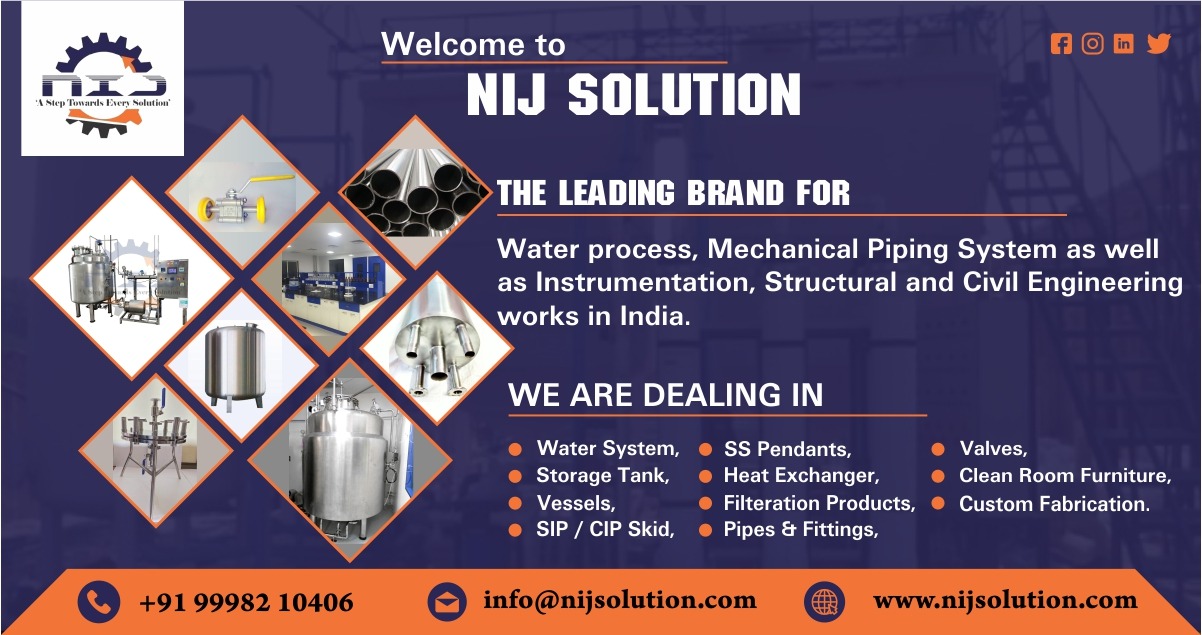
Nij Solution Pvt. Ltd. provides industrial equipment and engineering-related solutions, including heat exchangers, water systems, storage tanks, process piping, CIP/SIP systems, valves, filtration products, and custom fabrication.
Its published heat exchanger information discusses shell-and-tube construction, stainless steel material options, and applications in pharmaceutical, petrochemical, dairy, and food-processing industries.
For businesses searching for Industrial Heat Exchangers for Process Applications In Nagaland, manufacturing support from Ahmedabad, Gujarat, India, offers another sourcing option for discussing industrial thermal requirements.
Buyers can share their process details, fluid characteristics, temperature requirements, and installation conditions with Nij Solution Pvt. Ltd. through its website to understand the equipment suitability and quotation requirements.
Website: nijsolution.com
Industrial Heat Exchanger Requirements Across Nagaland
Nagaland has diverse commercial, manufacturing, food-processing, infrastructure, and industrial requirements where heating and cooling equipment may support process operations. The suitability of a heat exchanger depends on the specific facility and its operating conditions rather than location alone.
Industrial buyers and businesses across the state may explore sourcing support for process equipment in:
Dimapur, Kohima, Chumoukedima, Mokokchung, Wokha, Zunheboto, Tuensang, Mon, Phek, Kiphire, Longleng, Noklak, Niuland, Tseminyu, Peren, Jalukie, Pfutsero, Chozuba, Meluri, Shamator, Tuli, Changtongya, Bhandari, Doyang.
For projects in Nagaland, buyers should also evaluate transportation arrangements, site accessibility, installation planning, utility connections, and availability of maintenance support before equipment procurement.
Frequently Asked Questions
1. What is the primary function of an industrial heat exchanger?
It transfers heat between two fluids without directly mixing them. Industrial facilities use it for process heating, cooling, temperature control, and selected heat-recovery applications.
2. Which heat exchanger type is suitable for industrial process applications?
Shell-and-tube heat exchangers are used in many industrial processes. Selection depends on the thermal duty, fluid characteristics, pressure, temperature, material compatibility, and available installation space.
3. What information should buyers provide before requesting a quotation?
Buyers should share fluid details, flow rates, inlet and outlet temperatures, pressure conditions, required thermal duty, material preferences, and installation requirements.
4. Can buyers in Nagaland source heat exchangers from Ahmedabad?
Yes, buyers can contact manufacturers and suppliers based in Ahmedabad, Gujarat, for equipment sourcing. They should confirm product suitability, transport arrangements, installation coordination, and support requirements before ordering.
Conclusion
Industrial heat exchangers should be selected according to process conditions, thermal requirements, fluid compatibility, and maintenance access. Understanding these factors helps buyers avoid unsuitable equipment and plan installation more effectively. Businesses in Nagaland can discuss their industrial heating and cooling requirements with Nij Solution Pvt. Ltd., supported by manufacturing support from Ahmedabad, Gujarat, India.
Contact Nij Solution Pvt. Ltd. through its website to discuss your heat exchanger requirements, operating conditions, and equipment specifications.
Call Us:
+91 99250 57733
+91 99982 10406
+91 76985 37842
079-29611075
Email: info@nijsolution.com