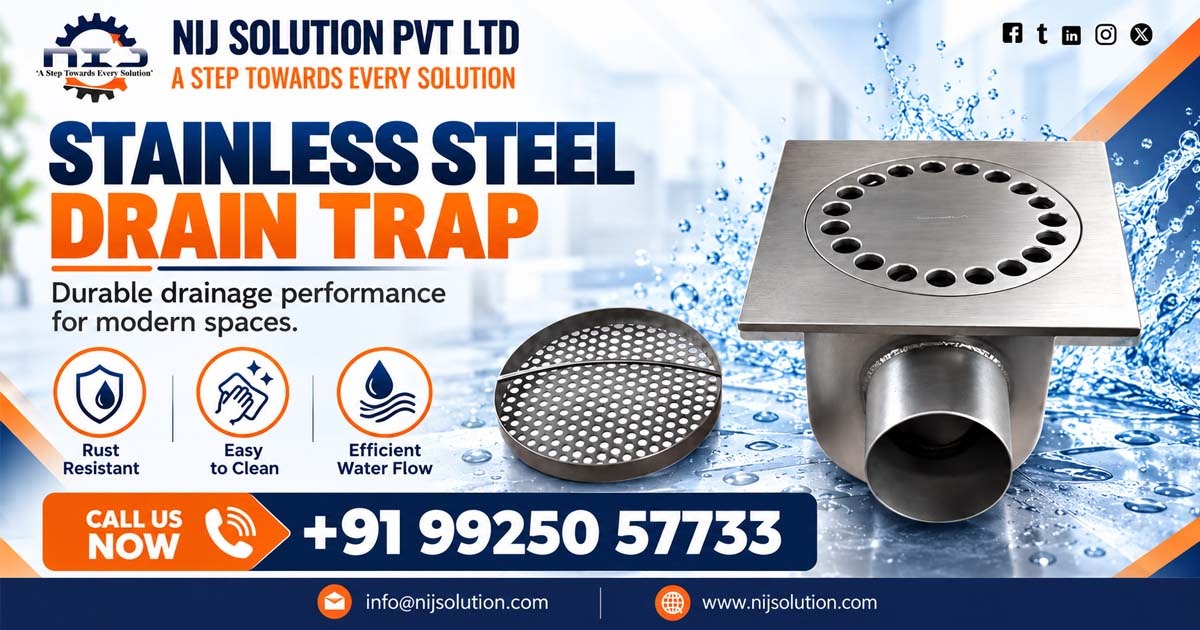
Drainage problems in processing or utility areas often begin with the wrong trap size, poor positioning, or difficult maintenance access. For buyers sourcing a Stainless Steel Drain Trap Supplier In West Bengal, checking site conditions and fabrication requirements early can prevent installation issues later.
Start With the Drainage Point, Not the Product Catalogue
A drain trap should be selected according to where it will be installed and what type of drainage it will handle.
Before requesting a quotation, identify:
- Drain location and available floor area
- Drain connection size
- Expected liquid flow conditions
- Type of wastewater or process discharge
- Cleaning requirements
- Required access for inspection
- Surrounding floor and piping arrangement
- Hygiene requirements of the installation area
For pharmaceutical, food, dairy, chemical, and other process environments, the drainage component should be considered as part of the overall piping and hygiene arrangement rather than as an isolated fitting.
What Should Be Checked in the Stainless Steel Construction?
Material selection matters because the drain trap may remain exposed to moisture, cleaning activity, and process-related liquids.
Ask the supplier to clearly confirm the proposed material grade and fabrication details. Depending on the application, buyers may need to evaluate stainless steel grade, thickness, surface condition, joints, connections, and finishing.
A useful purchase discussion should cover:
- Material grade
- Overall dimensions
- Connection arrangement
- Fabrication method
- Surface finish where required
- Accessibility for cleaning
- Compatibility with the surrounding drainage system
Do not assume that every stainless steel drain trap is suitable for every industrial environment. The actual operating conditions should guide the specification.
How Does the Drain Trap Fit Into the Process Area?
The drain trap normally forms part of the drainage route between the process or floor drainage point and the downstream discharge system.
A simple installation sequence is:
1. Drain Point
Liquid reaches the designated floor or process drainage point.
2. Trap Section
The trap provides the required drainage arrangement between the inlet and outlet.
3. Outlet Connection
The discharge is directed into the connected drainage or wastewater line.
4. Cleaning and Inspection
The arrangement should allow practical access for routine cleaning and inspection.
The exact configuration can vary with the plant layout and application, so the supplier should review the intended installation rather than assuming a standard arrangement.
Which Site Details Can Affect the Purchase?
A drain trap that looks suitable on paper may still create problems if its dimensions or connections do not match the site.
Before ordering, check:
| Site factor | Why it matters |
| Floor space | Determines whether the selected arrangement can be positioned properly |
| Drain location | Helps establish inlet and outlet alignment |
| Pipe routing | Prevents connection conflicts during installation |
| Floor level | Affects positioning and drainage arrangement |
| Cleaning access | Makes routine inspection more practical |
| Surrounding equipment | Avoids interference with machinery or walkways |
| Maintenance clearance | Allows access without unnecessary dismantling |
| Future modification | Helps accommodate possible piping changes |
For a new project, these details can be included during layout planning. For an existing plant, measurements from the actual installation point are especially useful.
What Should Buyers Check Before Comparing Suppliers?
When comparing a Stainless Steel Drain Trap Supplier In West Bengal, price should not be the only comparison point.
Ask each supplier for the same basic information so quotations can be evaluated fairly.
A practical supplier checklist includes:
- Proposed stainless steel grade
- Dimensions and connection details
- Fabrication approach
- Surface or finishing requirements
- Customization possibilities
- Inspection or quality documentation available
- Installation requirements
- Technical assistance
- Spare or replacement support where applicable
A supplier who understands the surrounding piping and process requirement can also help identify dimensional or installation issues before fabrication.
When Is Customization Worth Discussing?
Standard products may not always match an existing plant layout.
Customization can be worth discussing when the project has unusual:
- Drain dimensions
- Floor levels
- Connection orientations
- Space restrictions
- Pipe-routing conditions
- Cleaning-access requirements
- Existing equipment interfaces
However, customization should be based on actual measurements and process requirements. Buyers should provide drawings, photographs, dimensions, or site information wherever possible instead of relying only on a product name.
Installation: What Should Be Ready at Site?
The installation area should be checked before the drain trap arrives.
Confirm:
- Correct installation location
- Required floor opening or mounting arrangement
- Inlet and outlet alignment
- Piping availability
- Adequate maintenance access
- Space for cleaning
- Proper connection with the drainage line
- Safe access around the installation
After installation, the connections and drainage path should be checked before the system is put into routine use. Any site-specific testing or commissioning procedure should follow the project requirement and supplier recommendation.
Keeping the Drain Trap Easy to Maintain
Drainage components are exposed to debris, process residues, cleaning chemicals, and regular washing. Maintenance therefore depends heavily on keeping the trap accessible.
Routine attention can include:
- Cleaning accumulated residue
- Checking the trap and connected areas
- Inspecting joints and connections
- Looking for visible damage or corrosion
- Checking for blockage or restricted drainage
- Confirming that removable parts, where provided, remain accessible
- Inspecting the surrounding piping for leakage
The appropriate inspection frequency depends on the application and operating conditions. Follow the supplier’s recommendations where specific maintenance intervals are provided.
Services
- Requirement Discussion – Review the drainage application, installation point, dimensions, and operating conditions before product selection.
- Product Selection Support – Help identify a suitable stainless steel drain trap arrangement based on the project and piping requirement.
- Custom Fabrication Support – Discuss dimensional or connection-related modifications when the standard arrangement does not match the site.
- Technical & After-Sales Support – Assist with installation-related questions, product coordination, and technical requirements after ordering.
Location
West Bengal has a wide range of manufacturing, pharmaceutical, food processing, engineering, chemical, and industrial clusters where hygienic and practical drainage arrangements can be relevant. Kolkata, Howrah, Haldia, Durgapur, Asansol, Siliguri, Kharagpur, Dankuni, Uluberia, Kalyani, Rajarhat, New Town, Bidhannagar, Barasat, Barrackpore, Falta, Bantala, Panagarh, Raniganj, Raghunathpur, Barjora, Haringhata, and Jalpaiguri.
Planning the Requirement With Nij Solution
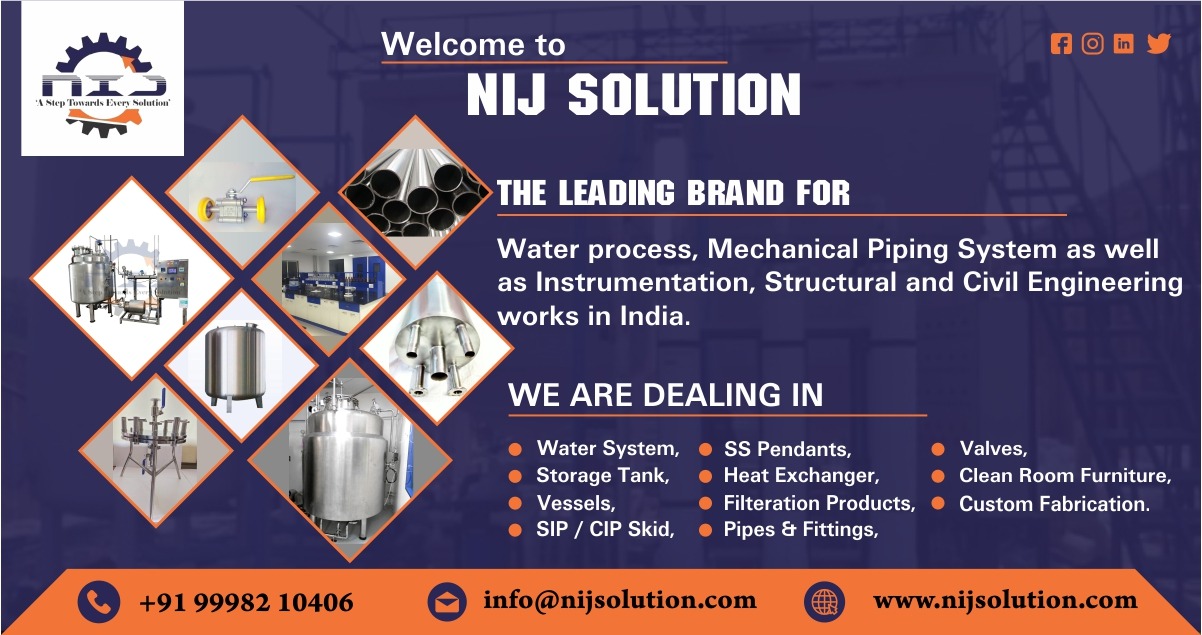
Nij Solution can be approached for industrial product and fabrication requirements connected with water-process systems, piping, fittings, valves, filtration products, and custom fabrication. For a Stainless Steel Drain Trap Supplier In West Bengal requirement, the discussion can begin with the intended application, dimensions, material requirement, installation conditions, and connection details.
Nij Solution provides manufacturing support from Ahmedabad, Gujarat, India, allowing West Bengal buyers to discuss requirements remotely before finalizing the product arrangement. The company website can be used to review its industrial product and service areas and initiate a requirement discussion.
FAQs
Q: How do I select a stainless steel drain trap for an existing plant?
A: Start with the actual drain dimensions, inlet and outlet connections, available space, drainage conditions, and cleaning requirements. Sharing site measurements with the supplier can help avoid dimensional mismatches.
Q: Can a stainless steel drain trap be customized for a specific installation?
A: Customization may be possible when the project requires different dimensions, connection positions, or layout arrangements. The supplier should review drawings or site measurements before confirming the design.
Q: What information should I send when requesting a quotation?
A: Provide the required quantity, dimensions, material preference, connection details, installation location, application, and any available drawing or photograph. This gives the supplier a clearer basis for preparing the requirement.
Q: What should I check after installing the drain trap?
A: Check the connections, alignment, drainage path, accessibility, and surrounding piping. The installation should also be inspected for leakage or other visible issues before routine operation.
Conclusion
Selecting a stainless steel drain trap is mainly a matter of matching material, dimensions, connections, cleaning access, and site conditions. Buyers in West Bengal should define these points before ordering and discuss project requirements with Nij Solution for suitable product and technical support.
Planning a stainless steel drainage requirement in West Bengal? Discuss your dimensions, application, installation conditions, product selection, and project requirements with Nij Solution.
Call Us:
+91 99250 57733
+91 99982 10406
+91 76985 37842
079-29611075
Email: info@nijsolution.com